Friday, 12 September 2014

TV Ads


Guide to an Analysis of an Advert

Choice of People – Have they chosen a celebrity or model to endorse their product?  Why?  What effect will this have on the audience?

Facial Expressions – If there are people / animals / characters in the ad, what do their facial expressions suggest about the product?  Do they tell you how you would feel if you bought the product?

Body Language – What does their body language tell you about how you would feel if you bought the product?  Are they close together, far apart?  Do they look energetic or relaxed etc?

Colour –What colours have been used in the advert and what do they suggest about the product / brand?  Are the colours associated with any particular emotions or feelings?

Lighting – Where is the light and shadow in the picture?  What effect does this have on the audience?  Does it draw your eye to any particular points?  What effect does it have on the look of the product?  Is it subtle or dramatic?

Slogans / Wording – Is it catchy?  Is there alliteration? What words have they used and why?  What do the words tell you about the product?  Are they using puns, plays on words, metaphors and similes?  Why? Do the words suggest something about the product?  Have they used scientific words or statistics to make the product seem professional and effective?

Font – Why have they used a certain font?  What does it tell you about the product / bran / target audience?  Is it big and bold, or small and delicate?  Is anything in a different font and why?  What about the size of the letters?

Props / costumes – what do the props and costumes in the ad tell you?  Do they suggest something about the person who uses the product?  Do they tell you something about the way the product will make you feel if you use it?

Image Size – Have they used close ups, wide shots, medium shots?  Why?  Do they want you to see detail?  Or do they want to show you the whole picture?

Image Angle – Have they used an eye level shot?  A low angle shot (looking up at something) or a high angle shot (looking down at something)?  What effect does this have?

Product – How and why have they shown the product and its packaging?  What does the bottle / packaging / appearance of the product suggest about it?

Other images – what do any of the other images suggest to the audience?  Eg background images etc..

Product Name / Company Name – what do they suggest to the audience about the product or the institution?  Eg The brand name “L’Oreal Paris” suggests the product was made or associated with a capital city famous for fashion.  This signifies to the audience that the product is fashionable and chic.

KEY WORDS TO USE (tick them off as you go and use them as many times as you can)
Connotation / Denotation
Signify / Signifies
Target Audience
Visual Codes... Costume / Facial Expression / Colour / Body Language / Graphics
Technical Codes... Sound / Editing / Framing / Lighting
Represents (eg the image of diamonds represents the product as being quality)
Stereotypes...Challenge or Reinforce
Slogan
Brand Image
Shot Type...Close up / Extreme Close Up / Medium Shot / Wide Shot / Extreme Wide Shot
Low Angle / Eye Level / High Angle
Product
Packaging
Institution

ABOVE ALL
You should be writing about WHO the product is aimed at and how you know that.. and HOW it makes an audience WANT the product...

Task 1: Analyse the Coco Chanel advert using media terminology.
Orange books 300 word essay

Monday, 8 September 2014

20 MS2 Coursework - Report

Learning objectives:
List five key points found from research that helped  to create artefacts as MS2 report is approached.

Approaching the MS2 Report

You will be shown how to approach your written report. This includes structuring using relevant terminology to demonstrate your own understanding.

Between 1200 and 1600 words
Your report should include:
A brief outline of the task.
A discussion of the most significant research findings which informed the pre production.
A brief justification of the target audience for the production.
An evaluation of the production which highlights its strengths and weaknesses through, for example, a comparison with existing media products.

Tips for writing a suitable report

The report must be 1200 - 1600 words and can be submitted in a range of different formats including; an essay or a suitably edited blog. The first part of the report outlines the research findings that informed your preproduction work and the second part of the report evaluates your production work.

The report is worth 40 marks so it is important that you spend some time ensuring what you write will pick up marks.

You must stay within the word limit and you should draft and redraft your report with Mr Ealey so that you achieve this

Use any notes you made when you were completing your preproduction artefact to help you to write the first part of the report.

Set out your aims clearly at the beginning of your report. This will ensure that your teacher and the moderator are clear about what you set out to do.

'My task was to create a storyboard, a DVD cover and two film posters for a gangster film. In order to accomplish this I had to engage in research of the gangster genre and the specific sub-genre of the gangster heist film.

Later in the report you can develop how you achieved your aims.

Briefly discuss the research undertaken and how it informed the pre production.
Include specific examples to back up your findings. For example, include references to specific films and and state what you discovered when you analysed them that informed your pre production.
Avoid statements like; ' I looked at a lot of magazine front covers...'
In other words, be specific and detail your findings.

Your aim is to demonstrate that your research enabled you to discover the key codes and conventions of your chosen genre which you then replicated in your work. If you are stuck then refer to the Media Studies blog and the examples that were set out during class.

Briefly discuss the intended audience for the pre production and production and explain how they have been targeted. Remember to justify your decisions

Evaluate the strengths and weaknesses of the production through, for example, a comparison with your production and existing media products.
Here you can include visuals, for example screen shots from your production and compare them to shots in a similar, existing text.

You will also need to complete a cover sheet. (See handout) outlining your preproduction and production. You will also need to briefly outline the focus of your report.

Task 1:
List in your orange books under the dated title ' Approaching MS2 report';
five key points found from your research that helped you to create your artefacts.


18 MS2 Coursework-Rough drafts

Learning objective: 
To rough out and annotate pre-production and production coursework with consideration given to the target audience.

Key words: Audience, visual codes, technical codes, mode of address, intertextuality.

You will be encouraged to consider the strengths, weaknesses and viability of your pre-productions before moving ahead with your pre-production work.

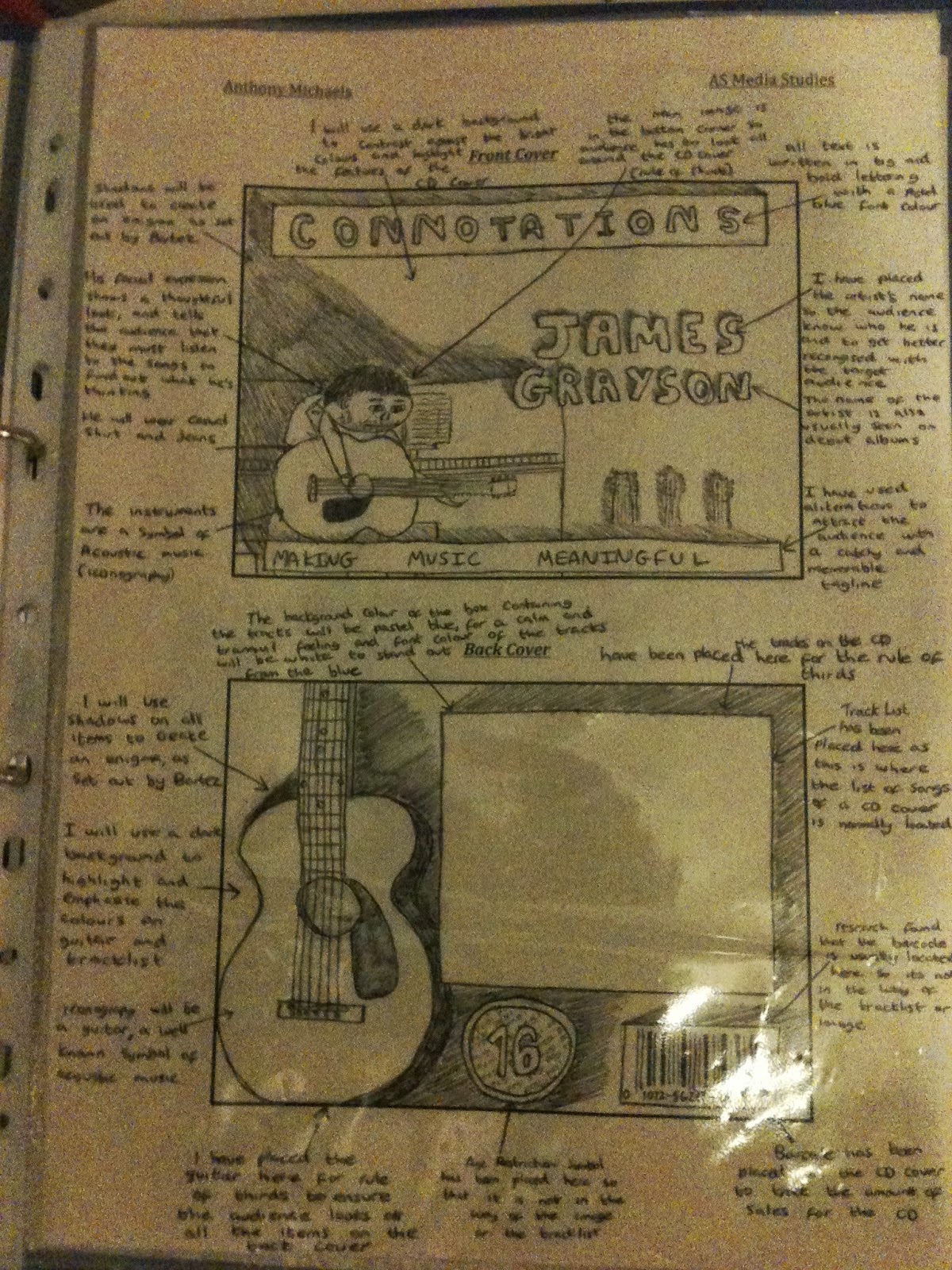
It is time to consider roughing out your pre production work.
You must know who your target audience is and how you are going to appeal to them through the use of generic codes and conventions.

Task 1: 
Rough out and annotate your ideas for pre-production coursework using the spider diagrams you have created to maintain focus on audience positioning.
Below is an example of a rough for a piece that scored highly.
You need to create something similar but this is not an art exam.


Task 2:
You will create a time management chart for the pre-production and production aspects of your coursework.


Work required for 30.1.15:

  • By close of business today you should have the following inside your folder:
  • Spider diagram of ideas for coursework.
  • Power point presentation showing examples of productions from within the genre you are dealing with.
  • Rough out on paper of your pre production plan. Annotated with comments on visual codes, narrative and any representation issues.
If these are complete you should create a time management chart which should include:

Dates set by you for completion of tasks.
  • Other people involved; actors, models, camera operators
  • Props required; costumes, hats, swords.
  • Make up, special effects.
  • Equipment required; SLR cameras, video cameras, memory cards, batteries, tripods, lights.
  • Software to use and time allocated for image manipulation.


17 MS2 Coursework Production (assessment HT3)

MS2 Coursework Production

Learning objective:


To continue with Coursework development for MS2 using examples from the genre.
Produce a Powerpoint presentation for assessment.

In preparation for your pre production and production coursework you should
1: Complete the spider diagrams
2: Create a Power Point Presentation which describes your intentions more clearly and uses examples of work that is in the same genre and either conforms to or challenges the codes and conventions for that genre.

Areas that must considered:
  • Iconography 
  • Mise en scene
  • Visual codes of costume, facial expression, colour, body language, graphics
  • Narrative structure
  • Technical codes of lighting, framing
  • Language used
  • Mode of address
  • Representational issues
  • Audience positioning
Use annotated images to show the work that you have explored in preparation

Print the power point presentations out two to a page and submit with your spider diagrams period six today.

Year 12 written tasks success criteria:
Knowledge of the concept of audience/representation/narrative
Awareness of relevant theories/debates/views
Uses examples to draw on relevant issues
Use of media terminology/key words
Quality of written communication


18 MS2 Coursework Production Magazine covers (assessment HT3)

MS2 Coursework Production

You will be guided in the codes and conventions of Magazine covers
(assessment HT2)

Key words: Encode, decode, polysemic.

17 MS2 Coursework Production - More exemplar

MS2 Coursework Production

You will continue to produce Coursework for MS2 and receive feedback

Key words: POV. Positioning. Preferred, negotiated, oppositional reading.

17 MS2 Coursework Production-Magazines double page spreads

MS2 Coursework Production

Learning objective:
You will be guided in pre production techniques of creating a double page spread for a magazine and asked to annotate the conventions of a correctly formatted example.

Key words: 
Image, quote, 11pt, Ariel, drop cap, columns, Mode of address, by-lines, colour scheme.


Task 1: 
Annotate two of the following magazine DPS's. 
Indicate the conventions used and comment on the mode of address in use.


Year 12 written tasks success criteria:
Knowledge of the concept of audience/representation/narrative
Awareness of relevant theories/debates/views
Uses examples to draw on relevant issues
Use of media terminology/key words
Quality of written communication

Peer Assessment.

Use the handouts provided to assess the work of your peer.
Award 20 marks for each of the success criteria indicated above giving a final total out of 100.
The assessment focus for this task is: DVD cover - codes and conventions

A*   91 - 100
A     81 - 90
B     71 - 80
C     61 - 70
D     51 - 60
E     41 - 50

Related link: Layout disasters